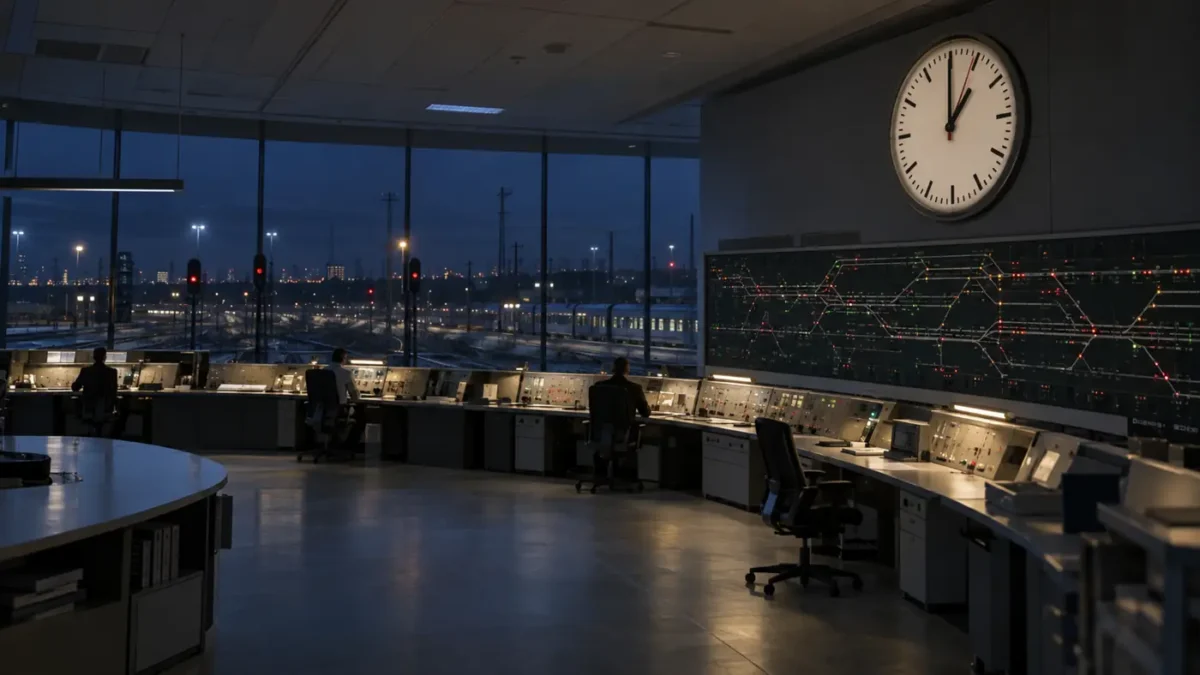
U.S. stock-market infrastructure is moving closer to round-the-clock operation, but the emerging model still differs sharply from crypto’s continuous 24/7 trading.
Nasdaq plans to add a 9 p.m. to 4 a.m. Eastern Time session on December 6 as part of a 23-hour, five-day schedule. The supporting infrastructure is also expanding: the National Securities Clearing Corporation began offering 24×5 clearing in June, and Securities and Exchange Commission officials said market-data infrastructure is set to expand to 23×5 on December 6.
Those changes narrow the gap between traditional markets and crypto. They do not eliminate it. The Nasdaq session is planned rather than live, the schedule still excludes part of each weekday and the weekend, and the latest SEC data show that overnight equity trading remains a small, unusually concentrated part of the market.
Overnight stock trading is growing from a small base
An SEC staff memo defined the overnight window as 8 p.m. to 4 a.m. Eastern Time. In August 2026, trading during that window averaged 144.6 million shares and $7.4 billion in value per day.
That activity represented 0.9% of National Market System share volume and 0.8% of dollar volume. Overnight share volume fell 27% from July, even as it remained 359% above its level a year earlier.
| August 2026 overnight measure | SEC staff data |
|---|---|
| Average daily share volume | 144.6 million shares |
| Average daily dollar volume | $7.4 billion |
| Share of NMS share volume | 0.9% |
| Share of NMS dollar volume | 0.8% |
| Change from July 2026 | Down 27% |
| Change from August 2025 | Up 359% |
The opposing monthly and annual comparisons matter. The year-over-year increase shows substantial expansion, but the monthly decline cautions against treating that growth as a smooth or settled trend.
Liquidity is more concentrated overnight
The ten most-traded stocks accounted for 43.4% of overnight volume in August, compared with 10.3% during regular trading hours. That concentration suggests that access to more trading hours does not by itself create equally deep activity across the market.
For crypto readers, this is the central distinction between availability and liquidity. A venue can be open while trading activity remains clustered in a relatively small group of assets. The SEC figures describe aggregate overnight equity activity, not the execution quality an investor would encounter in every stock or at every point in the session.
The market’s operating layers are moving on different schedules
SEC Trading and Markets Director Jamie Selway said four alternative trading systems offer overnight trading in U.S. stocks. He also noted that DTCC began 23×5 equity clearing in June and that market-data infrastructure is set to expand to 23×5 on December 6, allowing some approved exchanges to trade during those hours.
DTCC says NSCC clearing is available from Sunday at 8 p.m. through Friday at 8 p.m. Eastern Time. That is an important infrastructure step, but clearing availability does not mean every exchange or equity trades throughout the full window.
Nasdaq’s announced 9 p.m. to 4 a.m. session is another step toward longer access. Because the session is scheduled for December 6, however, it should be treated as a planned launch rather than a current market feature.
Why 23/5 is still different from crypto’s 24/7 model
The comparison is now more useful because U.S. equities are building market-data, venue and clearing support for longer sessions. Yet the distinction remains structural: the announced equity model is 23 hours on five days, while crypto trading is continuous across seven days.
The SEC’s September 17 roundtable addressed preparedness, surveillance, settlement, resilience and the possible effects of longer market hours, including the possibility of future 24×7 trading. The event was a policy and infrastructure discussion, not a rule, approval or launch announcement.
That boundary also separates the market-hours story from the SEC’s work involving tokenized stocks. The relevance to crypto here is an editorial comparison of operating models; the SEC materials do not establish a direct connection to a tokenized-stock rollout. Readers following that separate issue can see CRYPTO MAIN NEWS’s analysis of the SEC’s narrow tokenized-stock AMM pilot framework.
What to watch next
The immediate test is whether the planned December 6 infrastructure and Nasdaq session begin as announced. After that, updated data will show whether overnight trading gains a larger share of U.S. equity activity and whether volume becomes less concentrated.
Until those results arrive, the evidence supports a narrower conclusion: U.S. equities are extending their operating day, but they have not adopted crypto’s continuous 24/7 market model.
Investment disclaimer: This article is provided for general information only and does not constitute investment, financial, legal or tax advice. Digital assets are volatile, and all investment decisions and their consequences are your own responsibility.