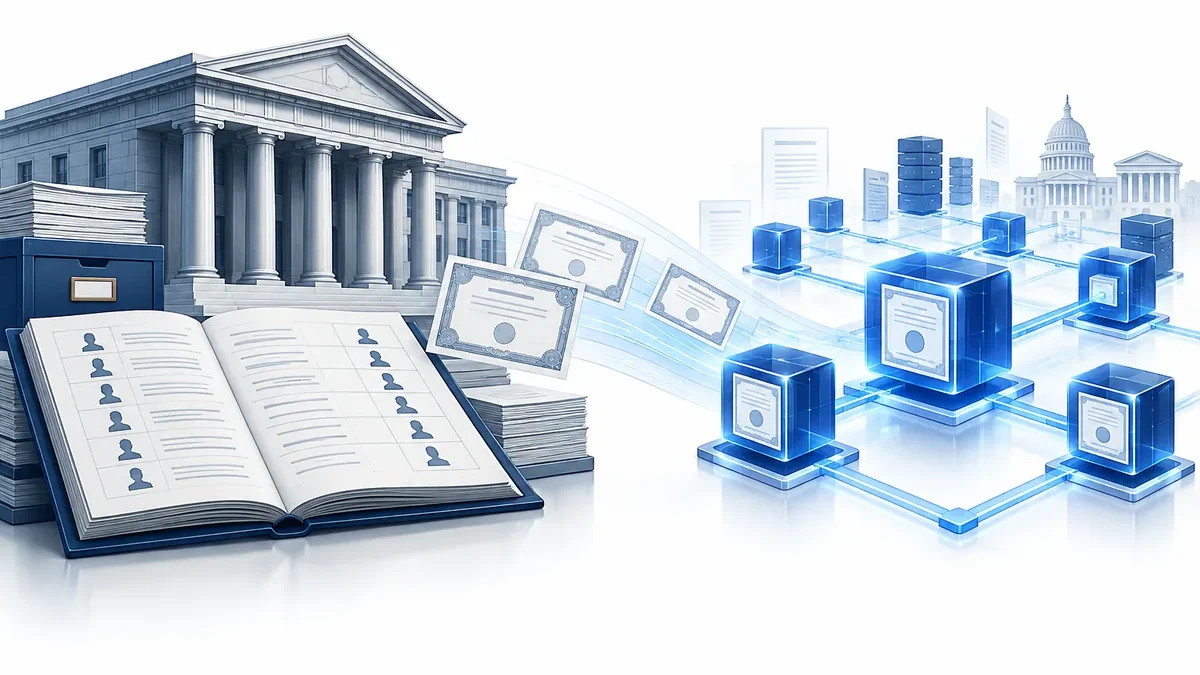
The SEC has put tokenized securities squarely inside a long-overdue rewrite of the rules for U.S. transfer agents. Its September 1 proposal would update recordkeeping, communications and operating requirements written largely for a paper-based market, while explicitly asking how those rules should work when ownership records and trades move onto blockchain infrastructure.
That does not amount to approval of tokenized shares, and it does not create a new exemption from federal securities law. It does something more basic: it begins defining how the official record of who owns a security should be maintained when the market’s technology changes.
Why transfer agents matter to tokenized markets
Transfer agents sit behind much of the plumbing that investors rarely see. They maintain ownership records for issuers, process transfers, cancel and issue certificates, and help resolve lost-holder and restrictive-legend problems. In a conventional market, those duties are distributed across databases, forms, account identifiers and service agreements.
A tokenized share can change the interface without eliminating those responsibilities. A blockchain may show that a token moved from one wallet to another, but an issuer still needs to know whether that movement represents a valid transfer of the security, who is entitled to shareholder rights and which record controls when systems disagree.
The SEC’s proposal says the rules have not been substantively updated since the late 1970s and early 1980s. It would modernize electronic communications and recordkeeping and address the use of blockchain technology directly.

The questions now on the SEC’s table
Commissioner Hester Peirce framed the practical issue in her statement on the proposal: if shares are tokenized, should a transfer agent be able to use a digital-wallet address or an email address instead of a physical address? She also asked how the rules should accommodate securities that trade onchain.
Those questions reach beyond data formats. Wallet addresses can identify destinations, but they do not by themselves provide the identity, contact information or legal status that an issuer may need. A workable system has to connect the onchain record to investor records, compliance checks and corporate actions without creating two competing versions of ownership.
| Rule area | Existing friction | Question for tokenized securities |
|---|---|---|
| Ownership records | Issuer records and market ledgers may differ | Which record is authoritative after an onchain transfer? |
| Investor identifiers | Rules assume conventional contact data | Can wallets or email addresses satisfy the requirement? |
| Settlement controls | Processes were built around intermediated systems | How should faster, onchain settlement be reconciled and supervised? |
The proposal reaches well beyond blockchain
Blockchain is one part of a broader modernization package. Commissioner Mark Uyeda’s statement points to proposed changes covering reporting, the handling of funds and securities, turnaround requirements, lost securityholders, restrictive legends and transfer-agent agreements with issuer clients.
That wider scope matters. Tokenized securities will not scale merely because a ledger can settle quickly. Transfer agents and issuers must also manage exceptions: a compromised wallet, a disputed transfer, a deceased holder, a court order, an outdated restriction or a corporate action that must reach every eligible owner. The difficult work sits at the boundary between software and legal rights.
What issuers and tokenization platforms should watch
For U.S. issuers, the main design question is whether a tokenization stack can produce a clear, auditable ownership record without depending on manual reconciliation after every exception. Platforms should be able to explain who controls changes to the record, how identity information is linked to wallet activity, how errors are corrected and how books remain available if a vendor or network fails.
Transfer agents, meanwhile, will need to judge whether new systems can meet operational duties at the speed investors now expect. The U.S. market already operates on a T+1 settlement cycle for most broker-dealer transactions, and some digital systems promise near-instant movement. Faster transfer does not remove the need for accurate instructions, safeguarded assets and a durable audit trail.
The proposal is still at the rulemaking stage. According to the SEC release, comments are due 60 days after publication in the Federal Register. Final requirements can change after that process, and there is no guarantee the commission will adopt every element as proposed.
The practical takeaway
The SEC is treating tokenization as a recordkeeping and market-infrastructure question, not only as a trading feature. That is a meaningful step for companies building tokenized shares, but it also raises the standard of proof. A credible product will need to show how blockchain entries connect to enforceable ownership, investor communications and transfer-agent controls.
For investors, the label “tokenized” says little on its own. The more useful questions are who maintains the official ownership record, what happens when a wallet is lost or compromised, and which regulated entity is responsible when the onchain record and the issuer’s books diverge.
Crypto Main News reviewed the SEC proposal and commissioner statements published September 1, 2026. This article is for informational purposes and is not investment advice.
Investment disclaimer: This article is provided for general information only and does not constitute investment, financial, legal or tax advice. Digital assets are volatile, and all investment decisions and their consequences are your own responsibility.